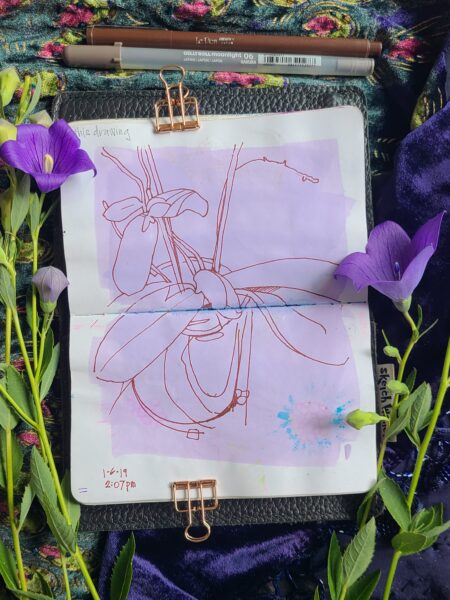
I didn’t plan to take eight years to fill a 60-page sketchbook. This is the truth about my eight year sketchbook: it has come with me to waiting rooms, airports, meetings, and to church.
Zero Regrets
Eight years later, it’s full. Even now I hesitate to call it finished. Since the video I posted below, I have added more drawings. This happens often. (To see the extra drawings, look for the sequel video that reveals what made me change how I feel about mistakes).
There’s still room on some pages. Little gaps. Empty corners. I might go back and fill them someday.
‘For everything there is a season, and a time for every matter under heaven.’ Ecclesiastes 3:1
This sketchbook had its own season—and I’m not ashamed that it took eight years.”
The Anti-Chronological Sketchbook
My sketchbook tendencies are not like most. I allow myself to skip around, to work on any page that moves me at the moment and to work on many sketchbooks at once. I have one for my purse, several for my Sunday school bag, one for the car and they all are appropriate in different situations.
The idea is to make it easy to draw whenever you find a moment. So if your favorite sketchbook doesn’t fit in your car, find one that does. Give yourself permission to work in both at once.
Why I Don’t Race to Finish Sketchbooks
Working in several sketchbooks at once makes them take longer to fill. Since filming the flip-through, I’ve already added more drawings. That’s one reason I hesitate to call any sketchbook finished. The point is not rushing to get to the next sketchbook; I am already working in the next sketchbook too.
The up-sides of working in multiple sketchbooks at once is freedom. I never feel trapped by a page I don’t like. I can skip around, abandon a spread, and come back months later with fresh eyes. Another up-side is I happen to have several sketchbooks that are reaching the fullness I like at the same time.
Filling up sketchbooks quickly is for other creators, for me – it takes as long as it takes. Filling sketchbooks fast is not my goal. Eight years. Sixty pages. Zero rules.
The Playground, Not the Portfolio
This sketchbook isn’t a portfolio. It’s a playground. A laboratory. A friend that tells the truth. A companion that reminds me of things that aren’t in the sketchbook.
This is what happens when you give yourself permission to treat a sketchbook like a sandbox instead of a gallery. A page is like sand – you can draw in it and start over and draw something else in the same spot. Someone said if your sketchbook doesn’t have any mistakes, then you are using it all wrong.
These methods reduce pressure. I tend to start a page with a wash, or a pattern just to remove the stark white page hesitation. All these freedoms cause a sketchbook to take longer to fill, but also cause me to return more often.
What I Wish I’d Started Doing Years Earlier
In my oldest sketchbooks, there are no dates on the pages and I found that this is unfortunate. Even then I allowed myself to skip around, so the other pages don’t give me a clue as to what year the drawing was made. Although I can see progress in my drawing skill and the kinds of drawings I used to make, I still long to know the exact date of each drawing.
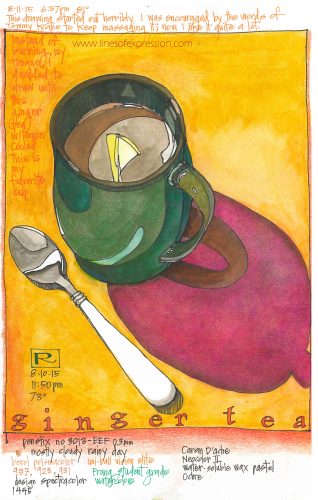
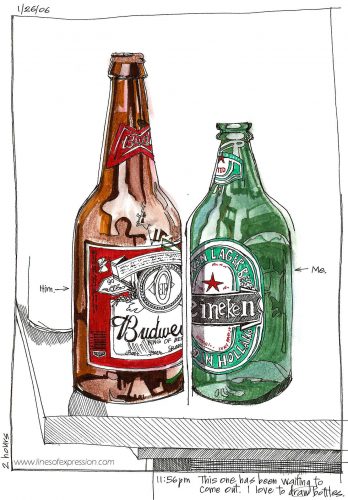
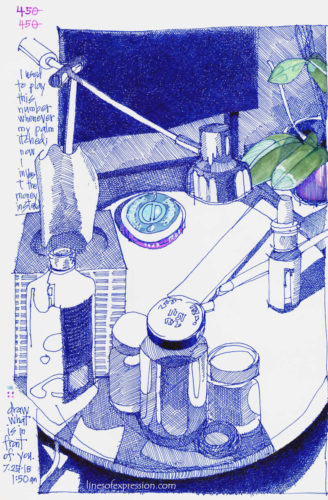
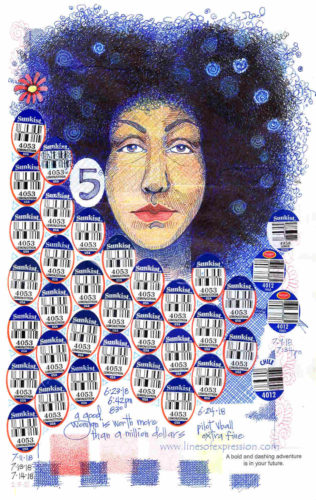
Now I am sure to date each page and even each time I go back to the page. Sometimes I also write the time and the temperature. I want to give myself an idea of the environment I was in or if the drawing happened when I should have been asleep.
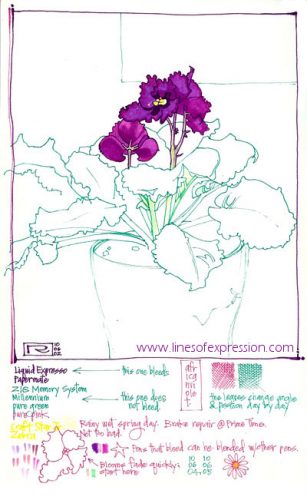
I try also to write the kind of pen I used. Since I find myself going back to a drawing repeatedly, it is helpful to be able to pick up the same pen. Or to know what kind of pens bleed through to the next page. Future Rebecca may need to know.
Now I draw on both sides of the paper. Even if the side before bled through to the next page, I will either use opaque tools (like Arrtx acrylic markers), or cover it with collage or gesso or I will use the splotch in the new design. Before I used to draw on only the right side of each spread and this gave a feeling of sparsity. But I prefer a feeling of abundance so using both sides of the page is both economical and makes a fatter sketchbook.
Why My Sketchbooks Never Feel Finished
My compulsion to use up every drop of a resource appears in my sketchbooks including this one. A lack of resources at Detroit Public Schools certainly helped me learn to use all of the page; to write smaller to fit everything in. And the influence of my BigMama (who lived through the Great Depression) also affected my thinking. She showed me how to repurpose old clothes into rags, to make sure to get the last flakes of butter off the the wrapper and she believed that doing this showed your gratitude for the item.
And I do too.
So I try to use every inch of the page. It doesn’t feel entirely finished unless the page is crowded. Every so often I will let a page have a minimal vibe. But mostly I like to push a page to its limit.
When the Page Goes Left
Not every drawing works.
Sometimes the page goes left. The proportions are off. The ink bleeds. The idea looked better in my head.
I used to tear pages out. I notice this tendency in the children that draw in my sketchbooks too. As soon as they don’t like it, they want to rip it out. But I don’t tear out the failures. Really any time I show up to the page it is a victory.
The mistake can be “pushed” to the background. Even if the marks are bold, you can reset the page. Also tearing weakens the spine. And when you tear enough pages out, your sketchbook gets thin. Nobody wants a thin sketchbook. The thicker, the better.
So I developed backup plans:
- Leave it. Let it stand as a lesson learned. Hard to look at, but honest.
- Collage over it. Paste a drawing from one of my doodle books (or other ephemera) on top.
- Paint it black. Draw on top of the black with white ink.
- Draw over it. Pretend the mistake isn’t even there.
- Gesso it. Prime the page white or tinted and start fresh.
Sometimes the do-overs go left too. Then I might pick a new backup plan. Or I might give up and turn the page. Sometimes I go back to it and I don’t know why I didn’t like it before.
The Kids at Church
I let children draw in my sketchbook.
It has been a dream of mine to have an artist friend to pass a sketchbook back and forth and add to each others drawings. I never thought the collaborators would be little people with short attention spans.
The sketchbooks or blank books are in my bag specifically for bored kids at church. I bring extra pens too. It keeps them quiet so I can hear the sermon, and enjoy the worship.
Most of those pages become collage practice. But occasionally, I leave them in. One child’s drawing remains in this book—and the others are covered. It isn’t personal; I collage over my own drawings often.
It’s not about the drawing. It’s about the moment. A child’s joy in making something. My willingness to let go of control.
The Real Truth
The flip-through shows what’s inside the sketchbook. The companion video tells the story of the woman who filled it. This sketchbook taught me patience and to be myself and to trust my process, even when that process is slow, messy, and nonlinear. It taught me that a sketchbook can be a companion, not a performance.
I don’t need to finish fast. I don’t need to show anyone. I don’t need to be good. I just need to keep showing up, keep making marks, and keep letting the pages fill up—one slow, chaotic, honest spread at a time.
The playground isn’t going anywhere.
Watch the Flip-Through
Now that you know the philosophy behind the pages, watch the silent flip-through to see 60 pages of drawings, doodles, collage, notes, and scribbles—all inside the leather sketch wallet I’ve carried for eight years.
Inside these pages, you’ll find:
- Portraits of strangers at airport gates
- Collage pieces (some torn from old diaries)
- Phone numbers, jokes, quotes, and scriptures
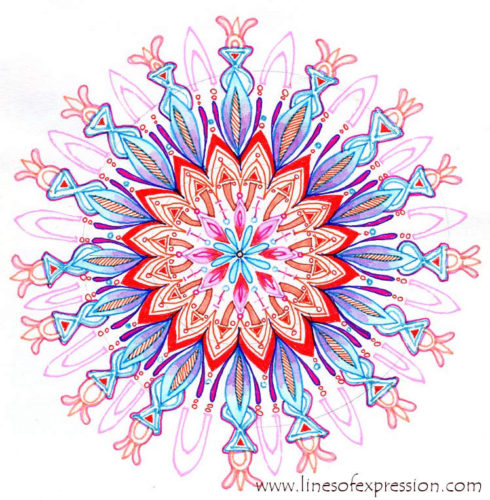
- Spirograph circles and mandalas
- Scribbles from bored children at church
- Swatches of different pen sets
- A self portrait
- Still life drawings and florals
Where creativity grows—on paper, in the garden, and at the table.
Next up:
📓 the missing portraits

Have you ever let someone else draw in your sketchbook—or would you?”